By Aaron Wolf Ph.D., Science Communications at Ancestry
If your family history has deep roots in England, you might be surprised to find some Sweden & Denmark or Norway in your AncestryDNA ethnicity estimate.
This doesn’t mean your results are less accurate—or that you have a secret Scandinavian relative. These results are typical for people with long family histories in England, especially in the eastern parts of the island.
That’s because your DNA tells the story of your recent family history and distant past (stretching back hundreds and thousands of years). Even back then, people from different parts of the world were moving around and interacting.
In this article, we’ll describe some of these patterns and how history shaped the DNA of people in England today.
How Vikings shaped the DNA of Britain
Long histories of movement and interaction between people from neighboring areas often mean they share DNA. The result is that even people whose families have lived in a single place for generations will likely have a mixture of ancestral origins.
For example, after the end of Roman rule in Britain 1,500 years ago, Scandinavian tribes settled in parts of Britain. First came the Jutes, Angles, and Saxons, who sailed from modern-day Denmark and Germany. They settled large parts of southeastern Britain. Then came the Vikings from modern-day Norway, Sweden, and Denmark. They took control over large parts of eastern and northern Britain.
Scandinavian and Northern Germanic tribes settled in the southeastern parts of Britain around 400 CE.
Scandinavian settlers had children with native Britons, sharing some of their DNA with the local population. That genetic connection between Scandinavian and British peoples persists in their DNA today.
How Ancestry uses science to explore history
To connect you to the places where your ancestors may have lived, we look at the DNA of living people whose families have lived in a single area—like eastern England—for several generations.
People whose family tree tips (the furthest generation back in each line) all go back to a single place are used as references for the DNA of a particular region.
Since we can’t easily excavate and extract DNA from ancient archaeological specimens, the DNA from people with long family histories in a place offers the best view of an area’s DNA profile and history. We use these people’s DNA as a reference panel to determine which populations your DNA looks most like from around the world.
That DNA from Scandinavian groups that settled in Britain is still present today in people with English ancestry. Interestingly, people with deep family roots in eastern England, where Scandinavian people settled, tend to have higher percentages of Sweden, Denmark, and Norway in their ancestral region results. People with deep roots in western England or Scotland tend to have lower levels.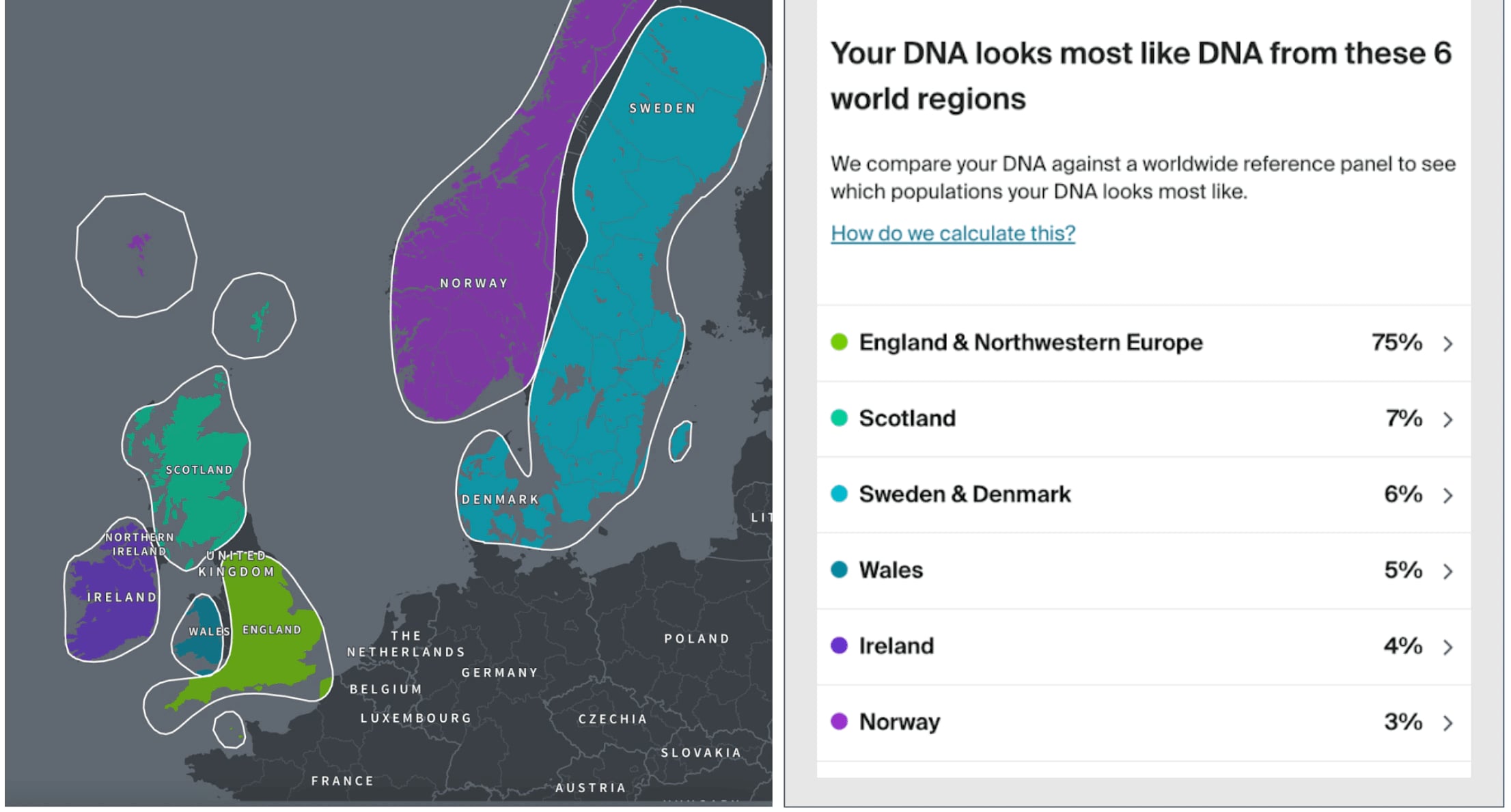
An example AncestryDNA test result for a person with a long family history in eastern England. Having some amount of Sweden & Denmark, and Norway is typical for someone with this family history.
Even if only part of your family tree is connected to England and you have inherited a small amount of English ancestry, your results might still show some Sweden, Denmark, or Norway. This small amount of Scandinavian DNA has tagged along with your England DNA as it was passed down through generations.
Discover more from your DNA
It can be exciting and surprising to look at your ancestral region results, but there are also plenty of other ways to explore your family story. Using your DNA matches and ancestral journeys, you can find living relatives, build family trees, and learn about your more recent family history, too.